

The bottleneck in automated industrial inspection is rarely data collection. Convolutional neural network (CNN)-based machine vision systems now routinely deliver reliable data across a wide range of processes.
The greater challenge is connecting that data to meaningful operator interaction and real-time control decisions, interpreting not just what the vision system sees, but what it implies for process state, maintenance, and output. A new approach to industrial process control, through the combination of machine vision, digital twins and edge AI, can offer clearer insights and smarter control of industrial processes.
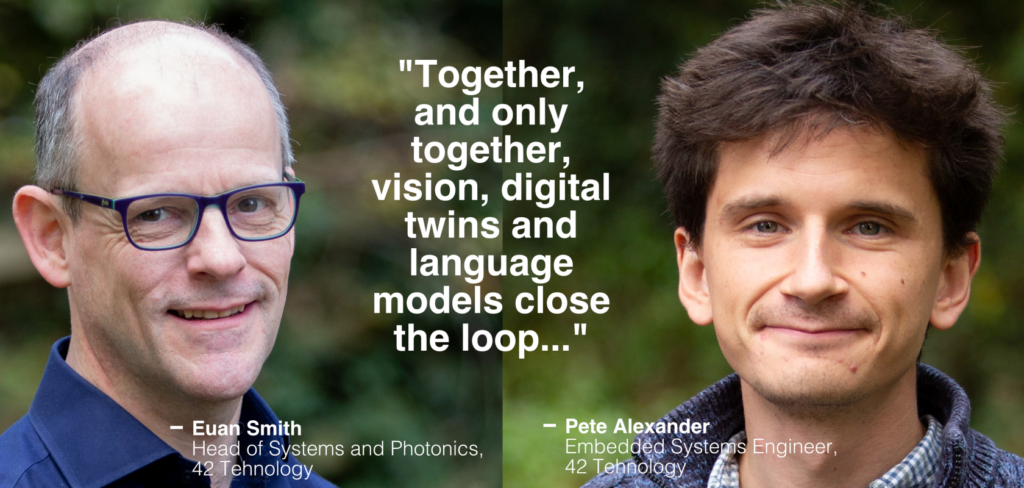
In a recent article for Imaging and Machine Vision Europe, 42 Technology’s Euan Smith, Head of Systems and Photonics, and Pete Alexander, Embedded Systems Engineer, explain how a three-component architecture could help bridge this gap. Using infrared drying of inkjet-printed aqueous inks as a worked example, the article examines how machine vision, a physics-aware digital twin and a small language model (SLM), constrained by a scaffolding layer, can work together to support better process understanding and operator decision-making.
Why integration matters
- Machine vision provides reliable defect detection and classification but offers little insight into underlying causes.
- Digital twins add the missing context by modelling process behaviour, predicting likely causes and showing how changes may affect outputs. However, their outputs can be difficult for operators to interpret quickly.
- SLMs can translate complex diagnostic information into natural-language interfaces. Yet, without a constrained framework, they cannot be relied upon as reasoning engines.
Together, these technologies have the potential to move industrial process control beyond defect detection alone towards clearer diagnosis and better-informed operator decisions.
All these components exist today. CNN-based inspection is mature; digital twin techniques are well-established; SLMs are rapidly improving and capable of running on industrial-grade edge hardware. Read the full article to learn how integrating these technologies could create new opportunities for industrial process control.
“Vision and twin complement each other. The twin predicts and explains, vision observes and corrects.”
As published in Imaging and Machine Vision Europe