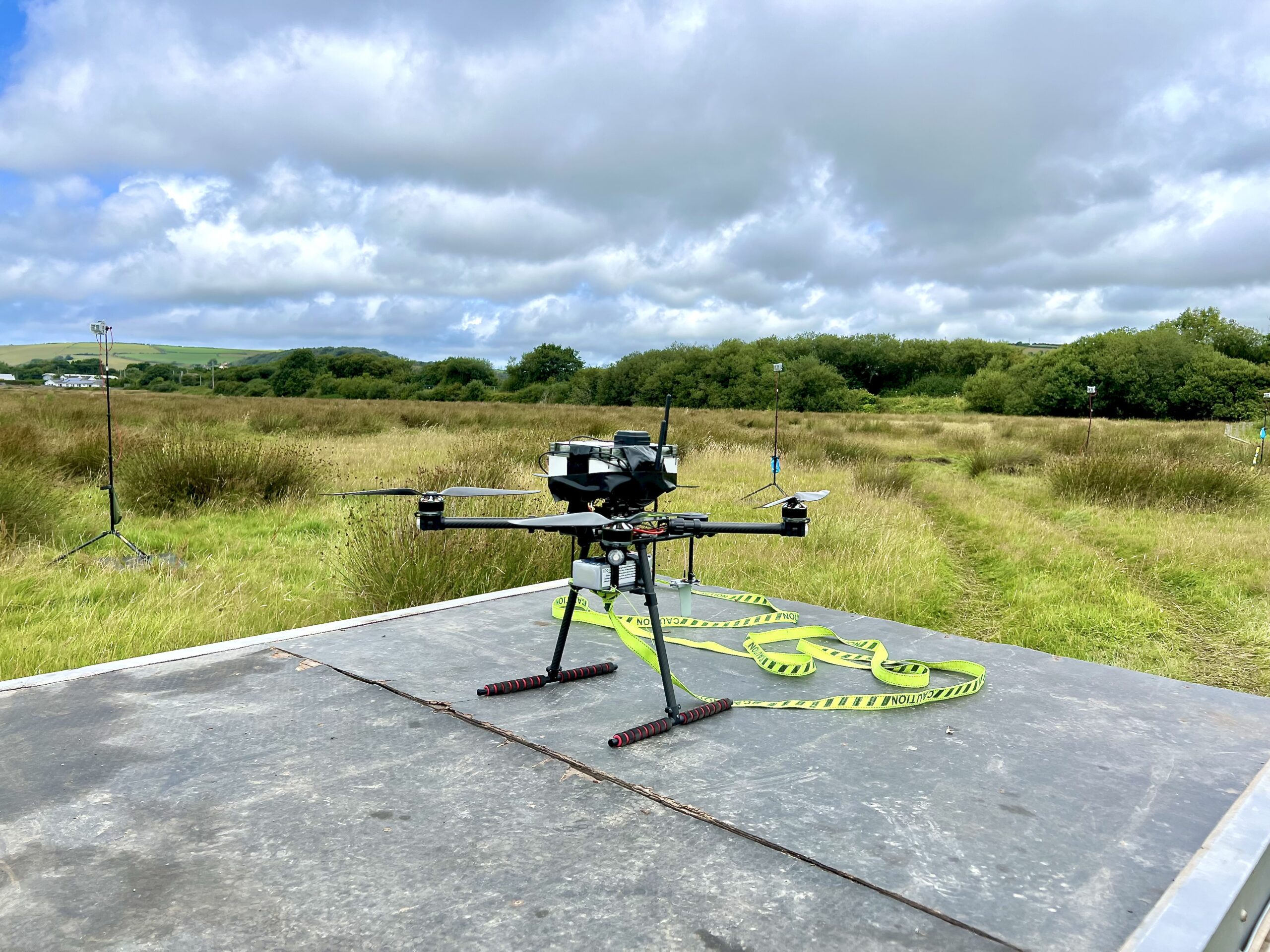
42T worked with Omnisense to extend the range of its ultra-wideband (UWB) positioning technology for the European Space Agency (ESA)-supported DroneHome programme. The programme helped demonstrate a terrestrial navigation layer that could support autonomous landing when satellite positioning became unreliable.
Key outcomes
Increased UWB operating range three- to four-fold, helping adapt the system for a more demanding real-world application.
Demonstrated predictable positioning when Global Navigation Satellite System (GNSS) was degraded, supporting safer approach and landing.
Combined RF development, testing and regulatory support to give the client clearer evidence for the technology’s route towards deployment.
The challenge
Satellite navigation is central to autonomous drone operation, but Global Navigation Satellite System (GNSS) signals can become unreliable in environments such as built-up areas, ports or tunnels. When this happens, autonomous systems need another dependable source of positioning information, particularly during landing when maintaining a controlled approach is critical.
Omnisense was developing DroneHome, an ESA-supported programme exploring how its ground-based UWB positioning technology could provide an additional layer of navigation when GNSS could not be relied upon. The original use case required accurate positioning over around 200 metres during the final approach of an autonomous aircraft. Achieving that meant significantly extending the range of Omnisense’s existing hardware, while working within the technical and regulatory limits of UWB transmission.
42T’s solution
42T collaborated with Omnisense to extend the operating range of the radio frequency (RF) hardware used within the DroneHome system, helping adapt its existing UWB positioning technology for the much greater distances required for autonomous aircraft landing.
By characterising the existing system through laboratory and field testing, 42T established the performance baseline. This informed the development of an enhanced radio front end combining improved receiver sensitivity and power amplification. Low-noise and power amplification, along with directional antennas, delivered a three- to four-fold increase in operational range.
Field deployments depended on the regulatory constraints around UWB transmission power. 42T assessed the relevant requirements, contributed technical evidence to regulatory discussions and supported the licensing needed for higher-power trials, which extended operational range to 200 metres.
Omnisense then integrated the improved UWB positioning system with GNSS and inertial sensing. Field trials and simulation-based analysis showed that positioning remained stable and predictable when GNSS was degraded, demonstrating that the technology could provide a more resilient navigation layer for autonomous approach and landing.
By combining RF engineering, sensing and regulatory expertise, 42T helped Omnisense extend the practical operating range of its UWB technology and demonstrate its suitability for a more demanding autonomous application. The work gave the DroneHome programme stronger evidence for safer operation when GNSS could not be relied upon, while creating a basis for further development across drone and other GNSS-challenged applications.
“We came to 42T because of their strong RF expertise and understanding of the regulatory considerations around radio systems. They worked closely with our team on the DroneHome programme, bringing useful insight to the technical challenges as they arose and helping us navigate a path through the practical RF and regulatory issues. Their practical, collaborative approach made them a valuable partner on the project.”
Why 42T?
Applying specialist RF expertise
Extending radio performance through hardware design, antenna optimisation and system-level engineering.
Reducing uncertainty through evidence
Using laboratory and field testing to identify where engineering changes would have the greatest impact.
Navigating regulatory constraints
Supporting development and testing within the requirements governing real-world deployment.
Paul has over 30 years of experience in electronics product development, spanning both technology consultancy and product companies. His particular focus is RF system and circuit design, radar systems, wireless communications and RF propagation.
Rowan has over a decade of experience leading the design and delivery of complex, high-risk hardware and embedded systems. With a background in physics and astrophysics, he brings deep technical knowledge and systems engineering expertise to product development.
Let us help you
We excel in deep innovation and technical breakthroughs, from early-stage exploration to end-to-end development and manufacturing.