Line clearance can create significant production downtime between batches, reducing available manufacturing capacity and increasing the cost associated with each changeover. As pharmaceutical manufacturers move towards smaller batch sizes and more frequent product changes, reducing this non-productive time becomes increasingly important.
To address this, 42T developed an Edge AI demonstrator combining industrial cameras, deep learning models and embedded processing into a single real-time system around the practical requirements of pharmaceutical production lines.
Key outcomes
Demonstrated the potential to reduce line-clearance time by up to 85% by automating multiple inspection points, increasing the amount of time available for production between batches.
Removed the need for cloud computing or additional processing hardware by running detection entirely at the edge, keeping image processing local to the system.
Combined Edge AI processing hardware, industrial cameras and deep learning models from three technology partners into a single real-time system designed to work with existing production-line environments, providing a route to automation without requiring entirely new inspection infrastructure.
Delivered real-time anomaly and contaminant detection on the conveyor system, identifying foreign or incorrect material during inspection.
The challenge
Line clearance, the process of checking that no materials, products, labels or records from a previous batch remain on a line, is one of the most critical steps in pharmaceutical manufacturing. Done manually, it can require multiple inspections and take up to an hour between batches. During this time, the production line is not manufacturing saleable product, reducing available production capacity and increasing the cost associated with each changeover. This challenge becomes more significant as the industry moves towards personalised medicine and smaller batch sizes, where more frequent changeovers can make line-clearance time a greater proportion of the overall production cycle.
Automated line-clearance systems must work with a wide range of existing cameras, equipment and production-line layouts. Dedicated solutions can be costly to scale, while implementation may involve complex integration and lengthy training on live lines. Across a large manufacturing site, these requirements can limit how widely automation can be deployed. No single technology addresses these requirements on its own. The system needed efficient Edge AI processing, cameras suited to industrial environments and a model-training approach that could reduce the set-up required on site, all integrated into one deployable platform.
42T’s solution
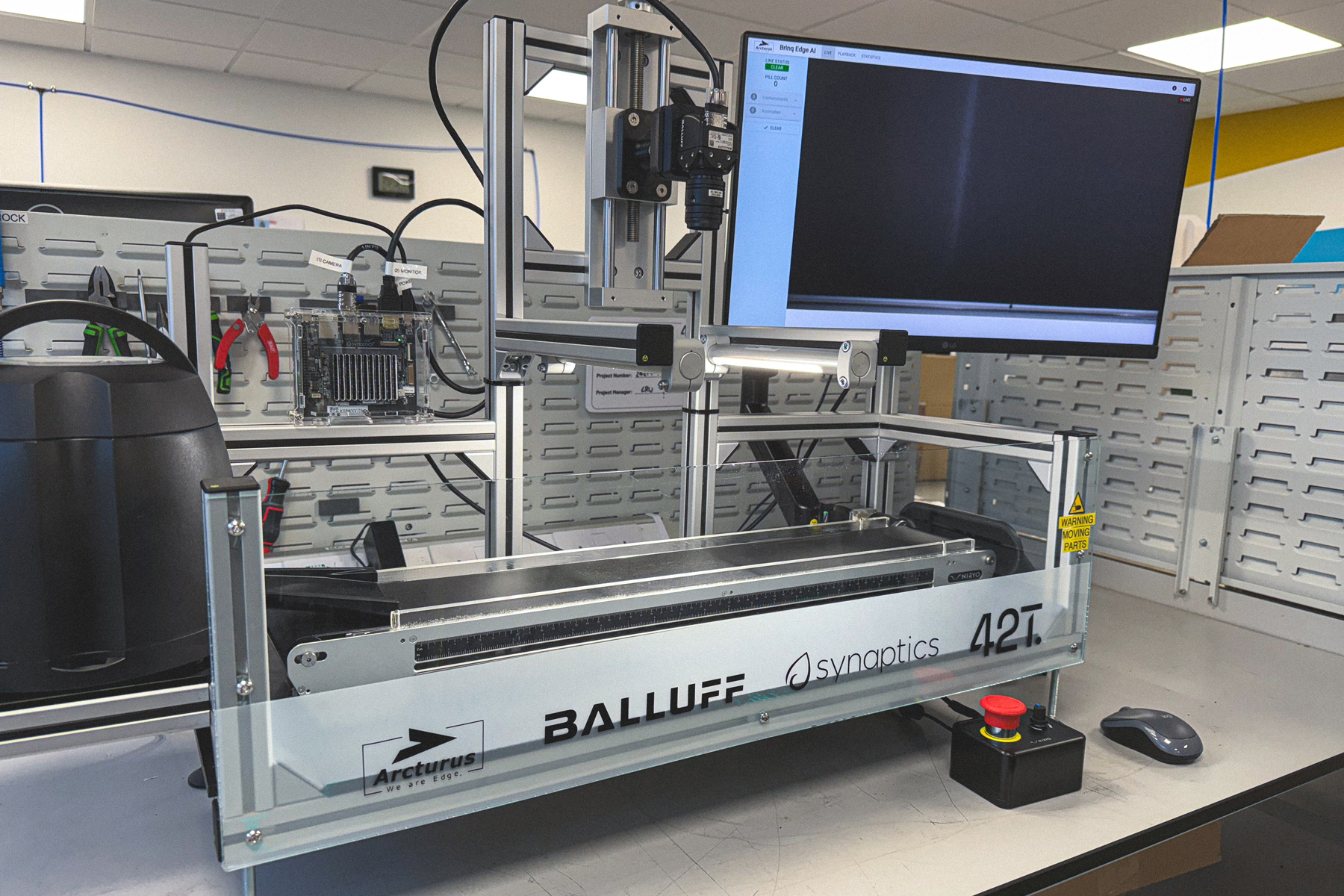
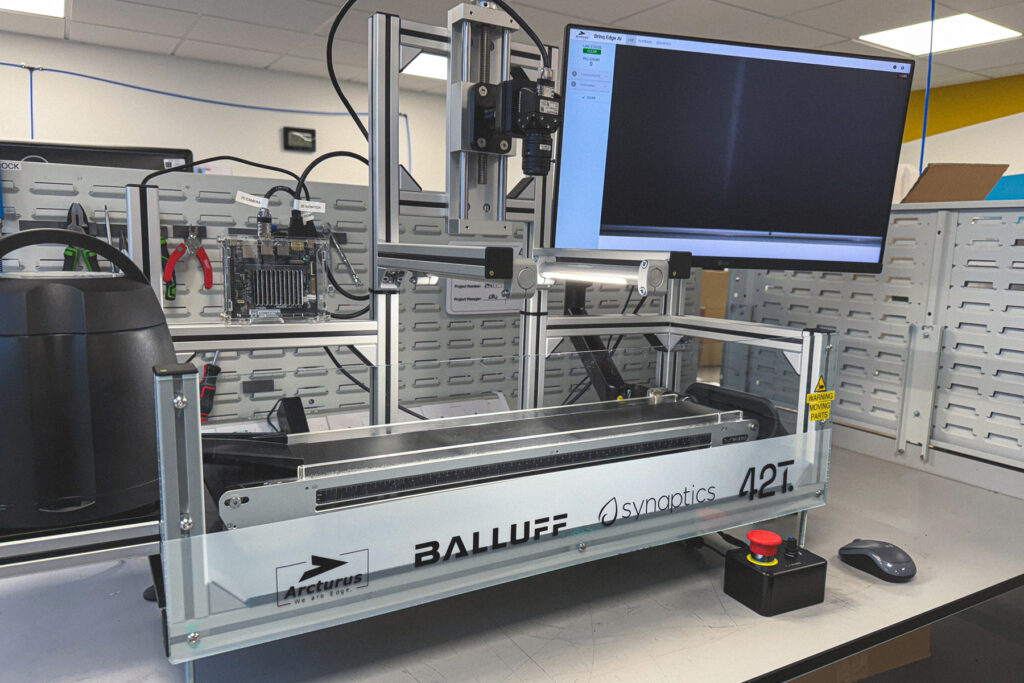
42T integrated Synaptics’ Astra Edge AI processor, Balluff’s industrial camera systems and Arcturus Networks’ deep learning models into a working demonstrator for pharmaceutical line clearance. The demonstrator showed the potential for multiple vision-based inspection tasks to run in real time on a single edge platform, without cloud computing or additional processing hardware. Processing images locally avoids dependence on cloud connectivity, reduces latency and supports real-time operation within the manufacturing environment.
42T led the system design and integration, covering CAD design and prototyping, UI development, Astra hardware integration, custom framework fabrication, and optimisation of the vision pipeline and machine learning models. The result was a unified system in which the hardware, cameras, models and interface operated together in real time. Drawing on its manufacturing and production-line automation expertise, 42T defined how the system would need to operate in a production environment and which detection capabilities it should include. The demonstrator was developed around five relevant capabilities: line clearance state, materials analysis, anomaly detection, contaminant detection and defect detection. It was also designed to support future integration with existing automation and production-line systems.
Fixed cameras positioned at key inspection points along the conveyor provided real-time monitoring of defined areas. By allowing multiple inspection points to be checked automatically rather than through a sequence of manual inspections, the proposed deployment was estimated to reduce line-clearance time by up to 85%. Data gathered during operation can be used to support further refinement of the deep learning models for future deployments.
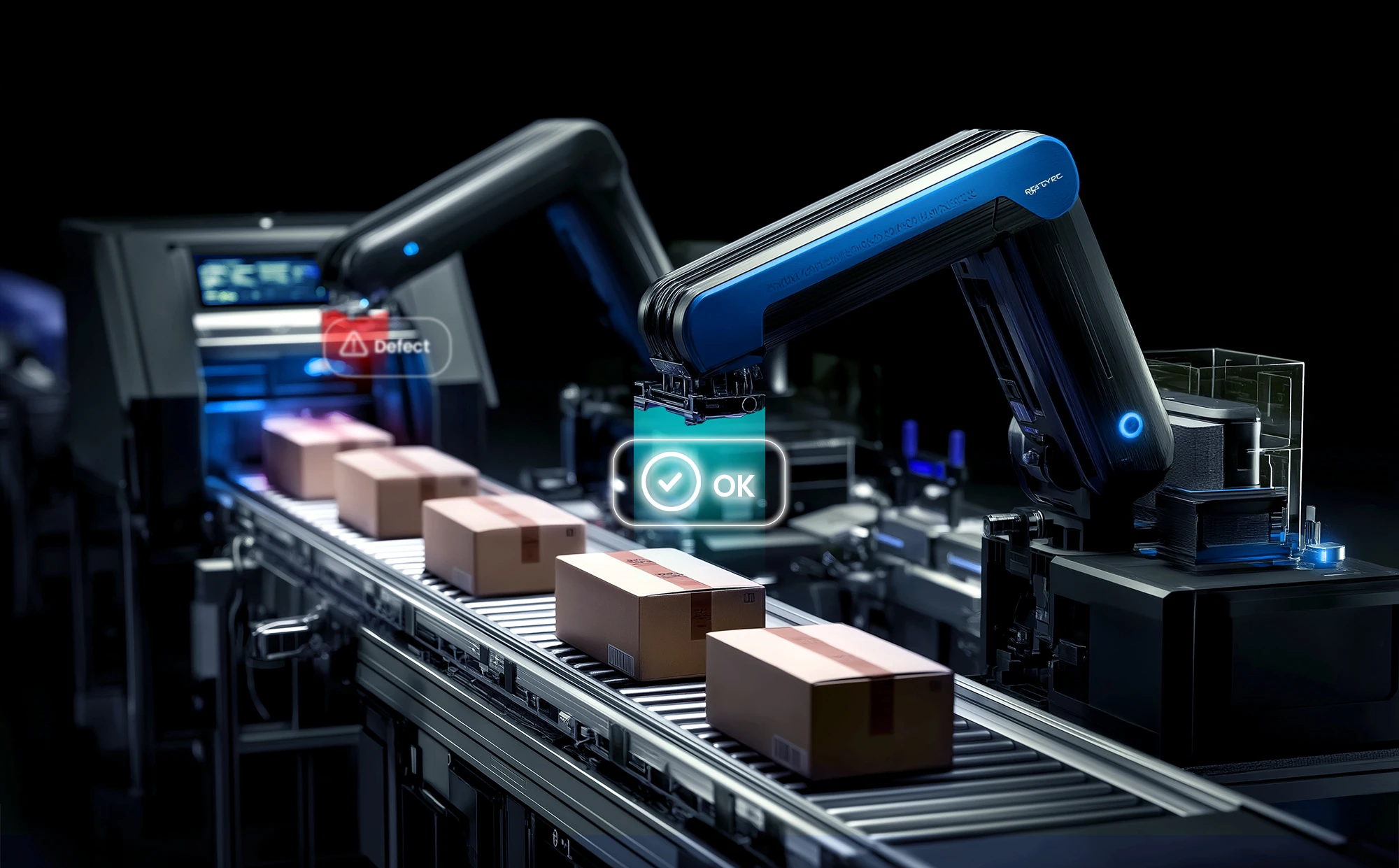
Although developed for pharmaceutical line clearance, the same integrated Edge AI, machine vision and embedded systems approach could be adapted for inspection, materials analysis, anomaly detection, contamination checks and defect detection across a range of manufacturing environments. The demonstrator provides a practical way for manufacturers to evaluate Edge AI before committing to full-scale deployment, helping reduce implementation risk, shorten the path to proof of concept and support progression towards production.
The completed demonstrator
“42 Technology’s manufacturing expertise and commitment to always finding the best solution for each of its clients makes them the ideal partner for Synaptics.”
Why 42T?
Manufacturing automation expertise
shaping systems around real production environments, operational processes and existing equipment.
Embedded AI expertise
deploying machine learning models on edge hardware for reliable real-time operation.
Complex systems integration
bringing hardware, industrial vision, software and machine learning together as one coherent system.
Stuart is Director of FMCG at 42T, with nearly 15 years of experience in technical consulting, product development, and innovation strategy. He specialises in food and beverage innovation, developing new products, packaging, and production processes for major FMCG brands and ambitious start-ups.
Mikhail is an Engineer at 42T, specialising in electronics and embedded system design. With a BEng (Hons) in Electronics and Electrical Engineering from the University of Edinburgh, Mikhail brings a hands-on, design-focused approach to developing innovative hardware solutions.
Let us help you
We excel in deep innovation and technical breakthroughs, from early-stage exploration to end-to-end development and manufacturing.