Users of complex industrial equipment often need to adjust settings or find technical information while carrying out hands-on tasks, with the guidance they need often buried within lengthy manuals. 42T developed an Edge AI voice control demonstrator to explore how operators could access equipment guidance and control through natural language. Using a signal generator as the demonstrator, the team showed how a locally hosted Large Language Model (LLM) could enable secure, hands-free querying of technical information and adjustment of equipment settings.
Key outcomes
Ran the complete application on local Edge AI hardware, avoiding cloud-hosted LLMs, external connectivity and per-use cloud processing.
Demonstrated access to equipment information and control through spoken natural-language commands.
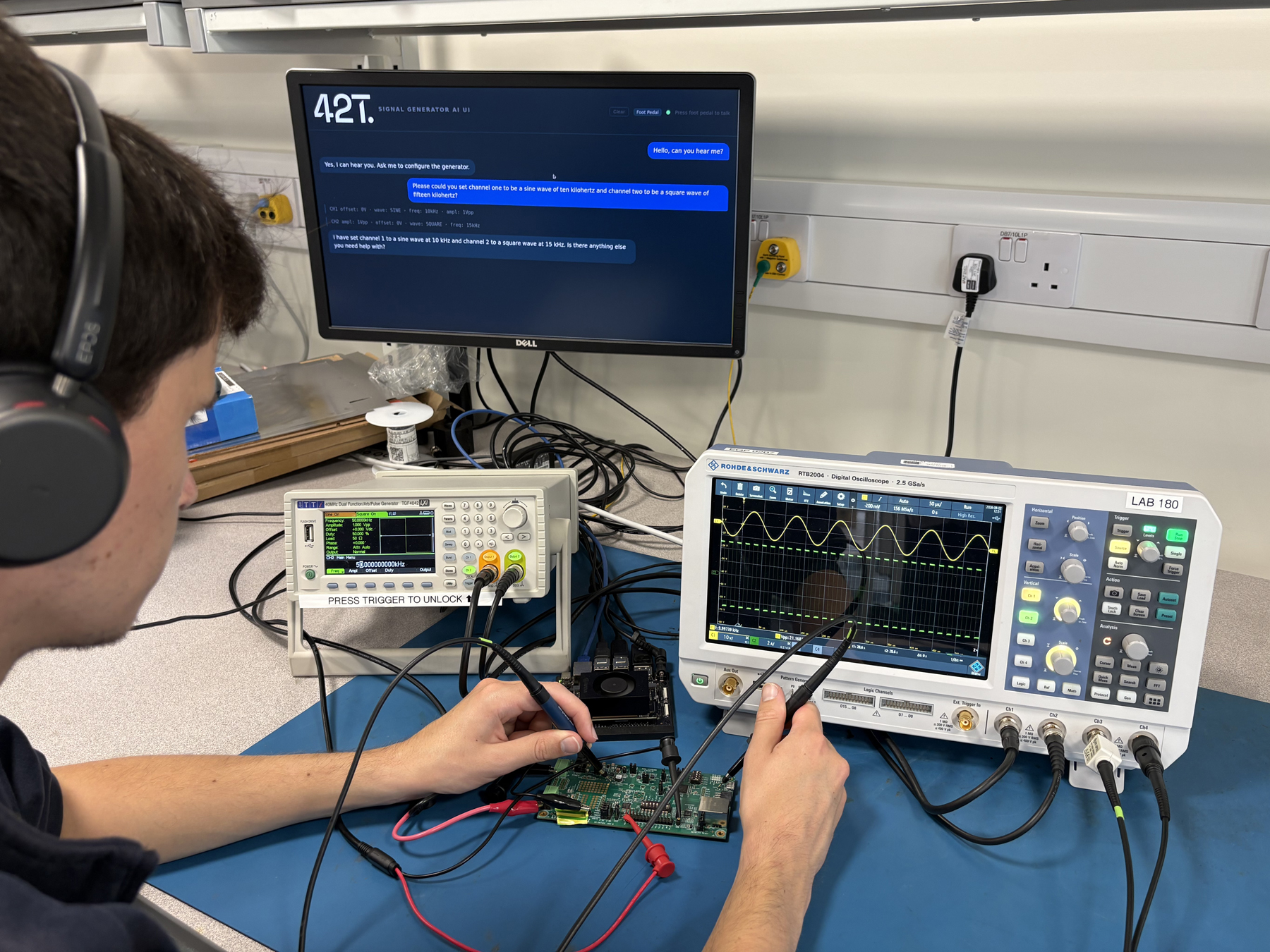
Used a noise-filtering headset microphone and foot-pedal trigger to support deliberate operation in noisy, hands-busy environments.
Demonstrating practical applications for AI
In industrial environments, operators may need to access technical guidance or adjust equipment settings while continuing with hands-on work. Conventional interfaces can require them to stop what they are doing, navigate device-specific menus or consult lengthy documentation.
42T built a working demonstrator to explore these questions through a defined industrial control task. The system connected the LLM to a signal generator through a function-calling interface, allowing it to interpret natural-language requests, retrieve the device’s current settings and initiate requested changes. This demonstrated how an LLM could move beyond a standalone conversational interface to support the querying and control of physical equipment.
Running the language model at the edge
Many LLM implementations rely on processing hosted in third-party datacentres. For industrial applications, this can introduce cybersecurity concerns associated with transferring operational data off-site, dependence on network connectivity, response latency and recurring usage costs.
42T developed the demonstrator as a fully local implementation. The LLM, speech-processing pipeline, user interface and equipment connection all ran on embedded Edge AI hardware, without reliance on a cloud service or supporting laptop.
Running the application locally imposed constraints on the processing power and memory available. Rather than relying on a larger general-purpose model hosted in the cloud, 42T configured the system prompt and function-calling interface around the functions of the signal generator and the technical language needed to control it. The LLM translated natural-language requests into structured status queries and device commands, while conventional control software used those outputs to communicate with the signal generator.
The system was designed to operate within predefined guardrails. The LLM could only access the status queries and control functions deliberately exposed through the function-calling interface, while conventional software remained responsible for validating and executing commands. For applications involving safety-critical actions, the architecture can also be configured to require explicit human confirmation before a command is carried out. This provided the level of intelligence required for the defined application without the computational demands of a larger cloud-hosted LLM. Other industrial applications may require cloud-based or hybrid architectures, but the demonstrator allowed 42T to establish what could be achieved through fully local processing.
Designing for the operating environment
The interface also needed to reflect how equipment is used in a laboratory or manufacturing environment. Operators may be holding tools, monitoring several process stages or wearing protective equipment, making keyboard-based controls less practical. Background noise and multiple machines operating in close proximity also make an open microphone or shared wake word unsuitable, as either could lead to unintended activation.
42T used a headset microphone with noise filtering to improve speech capture and a foot-pedal trigger to provide deliberate activation. Spoken requests were captured through the headset and interpreted locally by the voice-processing pipeline. This allowed the operator to issue commands without releasing tools or interacting with a keyboard, while reducing the risk of speech being detected by the wrong device.
The completed interface allowed the operator to request the signal generator’s current settings and issue changes through spoken natural language. This reduced the need to switch attention between the task, equipment controls and supporting documentation, allowing the operator to remain more focused on the work being carried out.
The completed demonstrator
The standalone system brought together the LLM, speech processing, function-calling software, user interface and physical equipment control on embedded hardware. It was demonstrated live at the Cambridge Wireless International Conference without reliance on cloud processing or a supporting laptop.
The demonstrator gave 42T a practical platform for evaluating how LLMs running locally on embedded hardware could be integrated into industrial systems. It also provided a basis for discussing where local, cloud-based or hybrid AI architectures may be appropriate for specific client applications.
“Production engineers and technicians often need quick, reliable guidance while working on live equipment but the information they need is usually buried across multiple manuals or in complex, menu-driven interfaces. Using a natural-language AI agent as a user interface means they can easily get accurate, context-aware answers without interrupting their workflow. They can simply ask questions such as, ‘How do I calibrate channel three?’ or ‘Why won’t the pump start?’ to get the support they need.”
Why 42T?
Industrial systems expertise
Grounding technology development in an understanding of manufacturing processes, equipment and operating conditions.
Intelligent systems integration
Combining AI, embedded software and physical systems at the level of complexity required by the application.
Human-centred engineering
Designing interfaces around the physical, cognitive and environmental demands placed on operators.
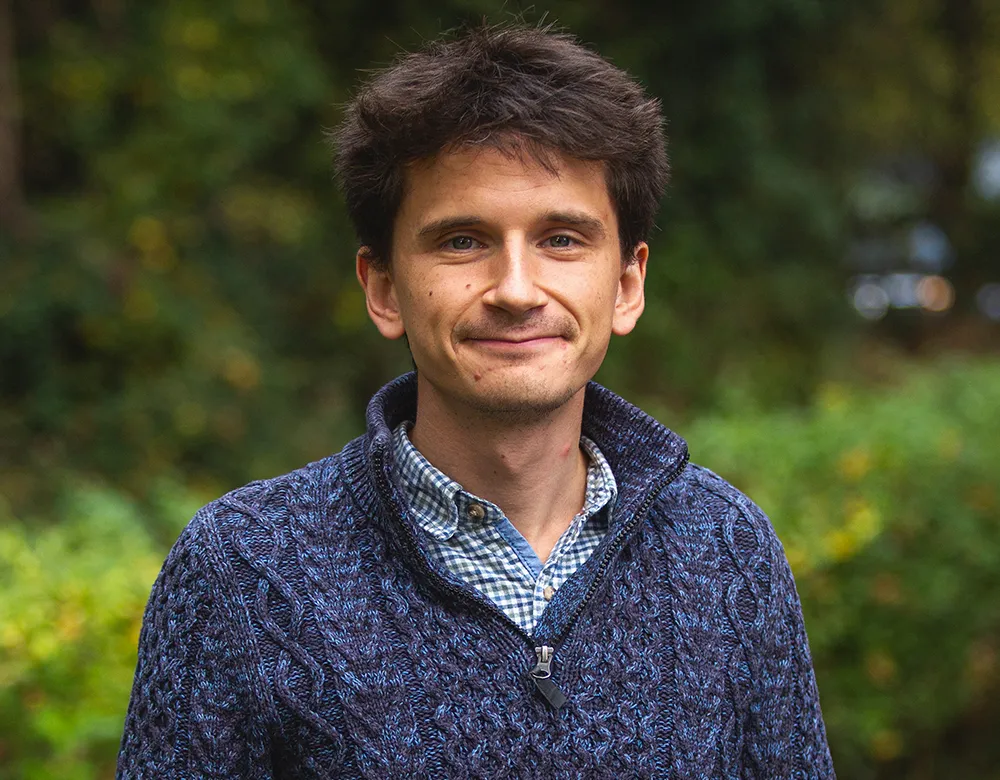
An embedded systems engineer with a Master’s degree in Electronics and Computer Systems from the University of Southampton, Pete brings experience across electronics, embedded systems and software development.
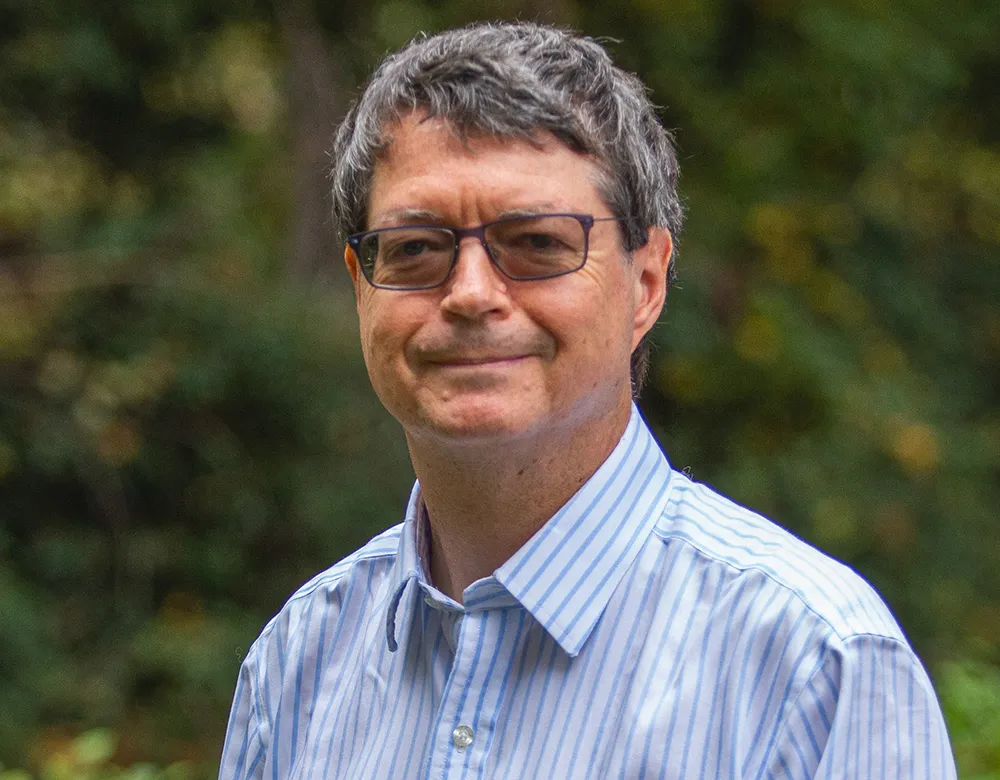
A Chartered Engineer with an MEng in Electronic Systems Engineering from the University of York, Mike brings deep experience across electronics, embedded systems, software development and intelligent systems.