Condition monitoring provides early warning of developing faults, helping reduce unplanned downtime and improve asset reliability. However, conventional monitoring approaches can be difficult to extend to equipment constrained by power, cost or connectivity.
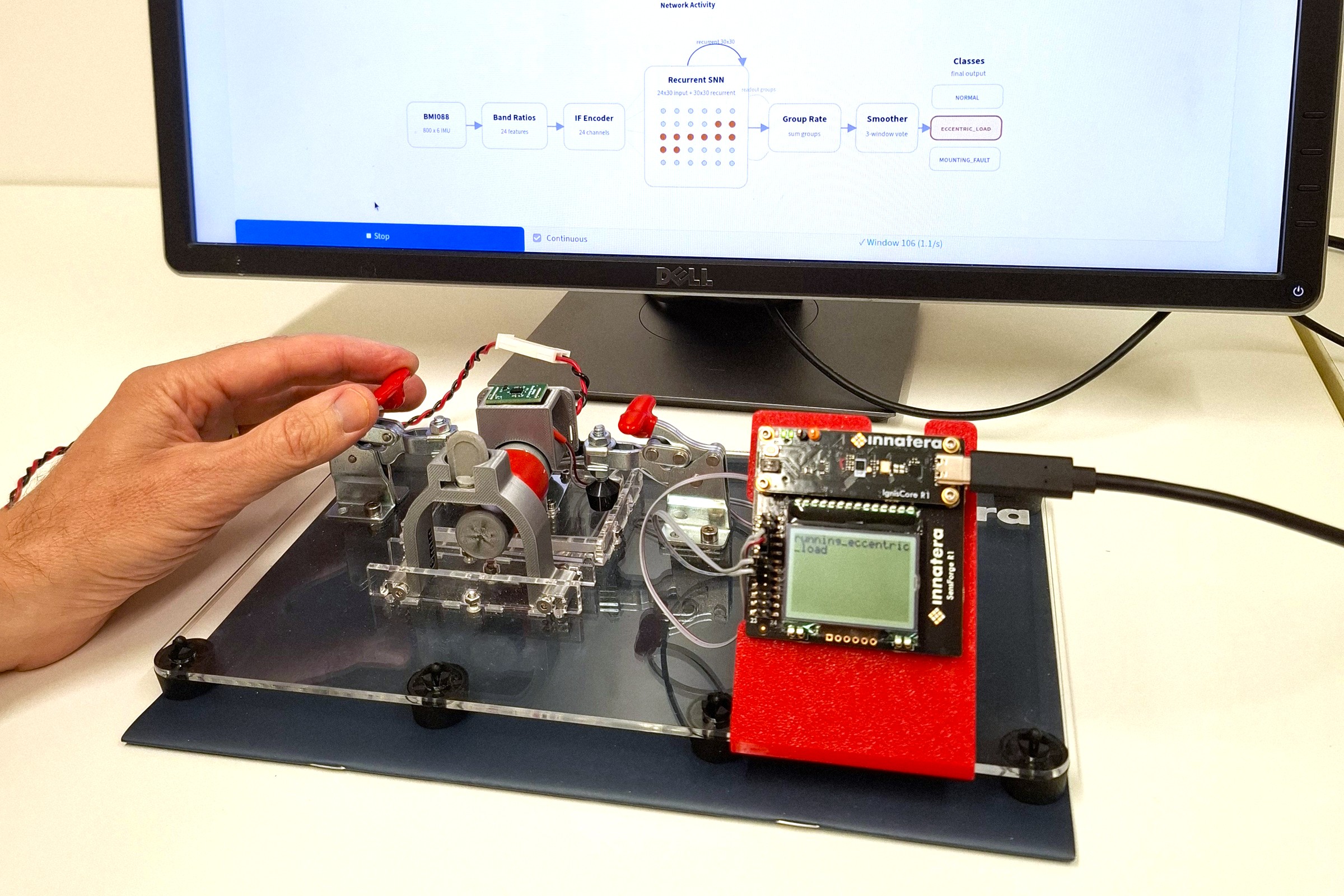
42T has developed an embedded Edge AI condition monitoring demonstrator using vibration sensing and a spiking neural network (SNN) to identify motor operating conditions locally and in real time. The demonstrator explores how neuromorphic AI could overcome these constraints, demonstrating the potential for always-on condition monitoring on a low-power microcontroller, without relying on a laptop or cloud connection.
Key outcomes
Demonstrating the potential for continuous motor condition monitoring using an ultra-low-power neuromorphic processor, supporting applications where energy consumption is a critical constraint.
Classifying four motor operating conditions, including healthy running, off, eccentric load and mounting faults, demonstrating the ability to distinguish between different equipment conditions as they occur.
Processing sensor data entirely on the microcontroller, without relying on a laptop or cloud connection and reducing the security risks associated with sending sensitive information to the cloud.
Showing how intelligent monitoring could be integrated into equipment where power, cost or connectivity constraints make conventional solutions impractical.
The challenge
Motors, pumps, fans and other machines exhibit changes in behaviour that can reveal changes in performance, wear and operating condition. Continuous condition monitoring can help identify developing problems and support condition-based and predictive maintenance, but the cost, power consumption and complexity of conventional systems can make it difficult to extend monitoring across every asset. Continuously transferring sensor data to a computer or the cloud can also increase power consumption, bandwidth requirements and latency, making conventional approaches less suitable for power-constrained or poorly connected applications.
42T set out to demonstrate an alternative: always-on condition monitoring that could operate locally within the power and computing constraints of an embedded device.
42T’s solution
42T combined embedded AI development, vibration sensing and mechanical design to create an interactive demonstrator capable of classifying four motor operating conditions in real time. Vibration data from the motor is processed by a trained SNN on Innatera’s Pulsar neuromorphic microcontroller, with pre-processing, inference and fault classification performed locally on the device. The SNN processes information as sparse, time-based events, supporting always-on condition monitoring at very low power. A host computer is used only to visualise the results; it is not required to perform the analysis. No machine data needs to be sent to the cloud, reducing the security and privacy risks associated with transmitting operational data off-device.
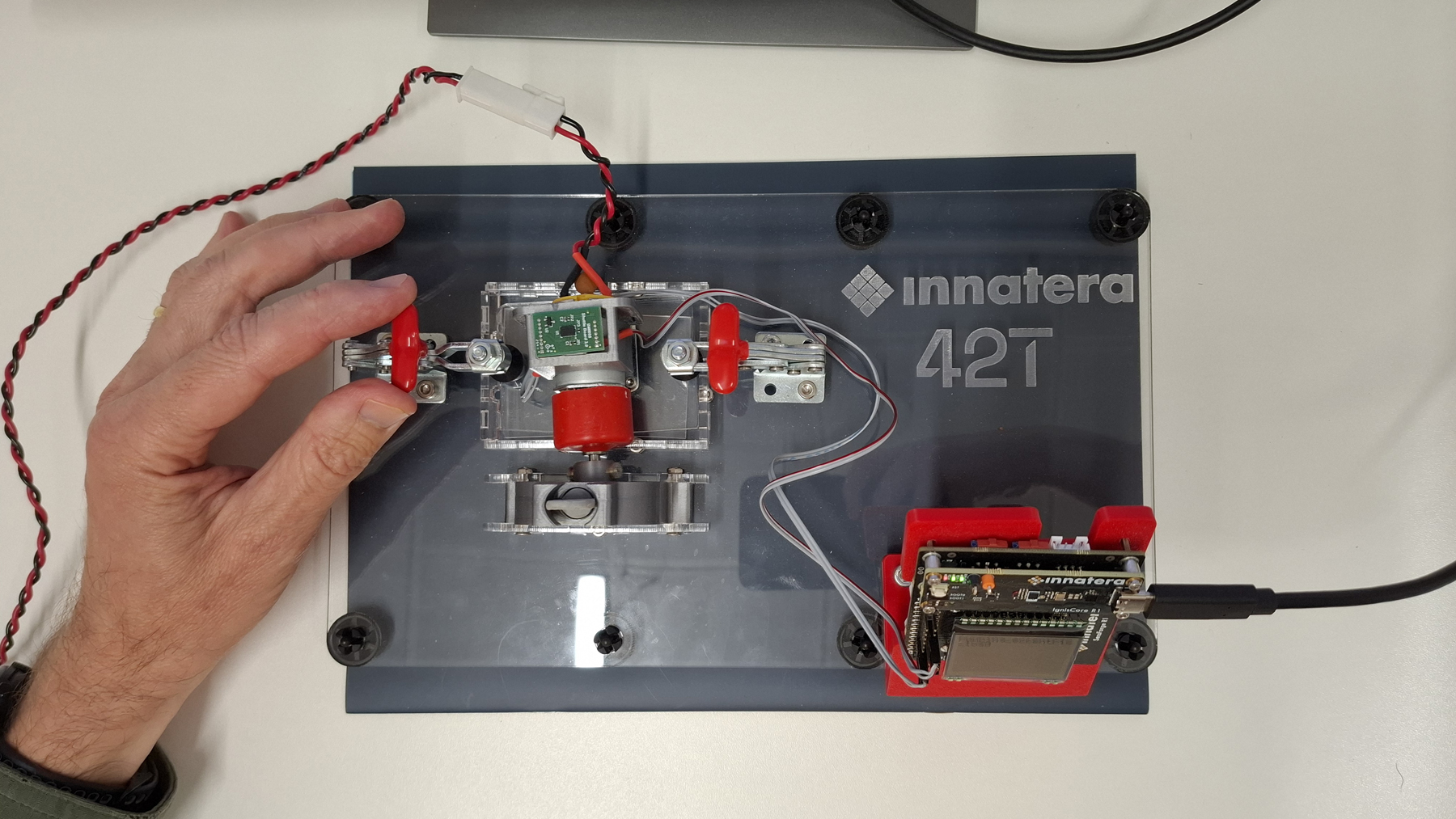
42T integrated the electronics into a mechanical rig with an adjustable eccentric load and configurable mounting arrangement. A presenter can switch live between four motor conditions: off, healthy running, eccentric load and mounting fault, without stopping the motor or reconfiguring the rig.
Running the analysis locally on an ultra-low-power neuromorphic processor shows how always-on condition monitoring could be incorporated into compact, battery-powered devices. These could be used as retrofit monitors or integrated directly into new products and equipment, including assets in remote or difficult-to-access locations.
Although demonstrated through motor vibration monitoring, the underlying technology has much wider application. The same principles could be applied to other time-series sensor data, including audio, current, voltage, power and temperature, and could support both condition classification and anomaly detection. This creates opportunities for always-on intelligence in products and equipment operating under tight power, computing or connectivity constraints.
The demonstrator has been showcased at CES 2026, Cambridge Wireless, embedded world and MWC Shanghai 2026. The interactive rig makes neuromorphic Edge AI tangible, allowing organisations to see how always-on intelligence can operate within tight power constraints and explore where it could be applied in their own products or operations.
“Commercial value can be maximised when you can see and fix problems before your customers ever feel them. By combining our innovative product development and sensing expertise with Innatera’s Pulsar microcontroller, we can capture minuscule changes in vibration, classify faults directly on the device, and create a practical path to self-diagnosing motors, fans, and pumps into their next generation of products.”
Why 42T?
Embedded AI expertise
Developing lightweight, on-device AI systems that operate within the power, processing, memory and connectivity constraints of real-world products and equipment.
Application-specific sensing
Designing and integrating sensing systems to capture reliable, application-relevant data under real-world operating conditions.
Emerging technology adoption
Turning new technologies into practical demonstrators that reduce risk and support commercial development.
With over 30 years’ experience in electronics and product development, Paul brings extensive expertise in sensing technologies and embedded intelligence. His work includes developing intelligent connected devices for applications such as condition monitoring and Edge AI.
Mike is a Chartered Engineer with an MEng in Electronic Systems Engineering from the University of York. His experience spans electronics, embedded systems, software development and intelligent systems, with a particular focus on AI and its practical applications.
Let us help you
Explore how embedded AI and intelligent sensing could improve your products, reduce reliance on cloud processing and make continuous, low-power monitoring practical.