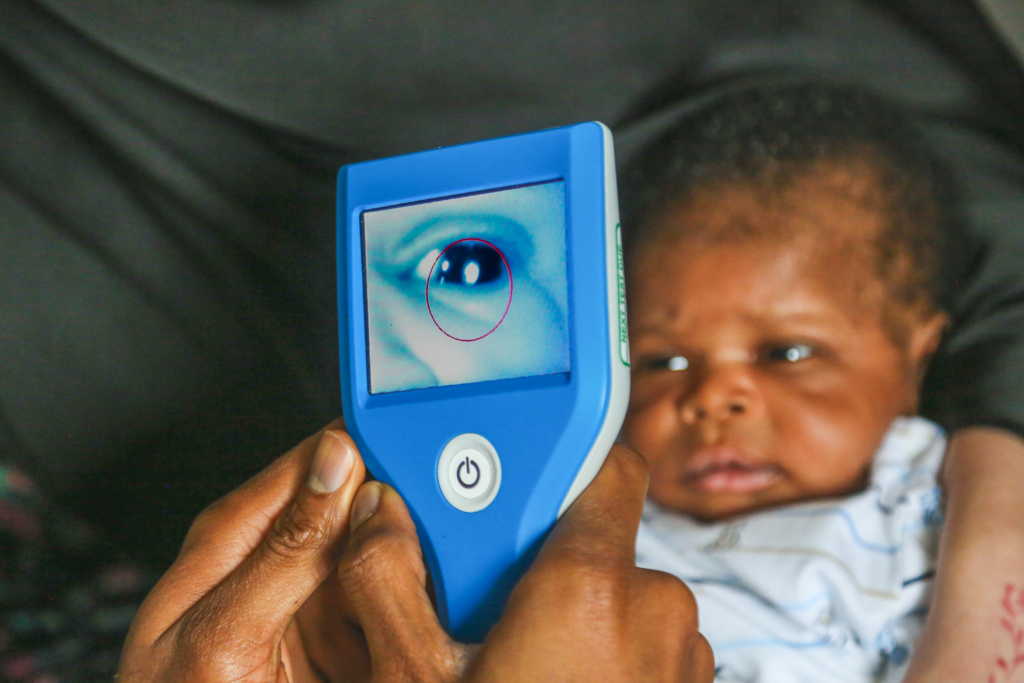
Newborn eye screening can miss cataracts or generate false positives, creating a need for a more consistent and practical approach. Neocam Ltd wanted to turn an optical imaging concept originating from Dr Louise Allen at Addenbrooke’s Hospital into a handheld device suitable for wider clinical evaluation and future manufacture. 42T brought together product design, optics, electronics, software and medical-device development to make that possible.
Key outcomes
Created a practical handheld device for clinical evaluation, moving Neocam beyond an early optical prototype.
Enabled larger-scale field evaluation, progressing development towards approximately 60 field-trial devices.
Reduced commercialisation risk by considering usability, regulatory requirements and future manufacture throughout development.
Supported the subsequent collection of thousands of clinically assessed infant-eye images through the NIHR-funded DIvO study.
The challenge
Cataracts are a leading cause of preventable sight loss in newborn babies, making early identification and treatment critical. During the first weeks of life, the eye and brain need to form an effective visual connection. If a congenital cataract is missed and treatment is delayed, this development can be disrupted, resulting in permanent vision loss. Existing screening methods can produce both missed cases and false positives, creating a need for a more consistent way of capturing and assessing the eye reflex.
The concept originated with Dr Louise Allen at Addenbrooke’s Hospital and used infrared illumination and digital imaging to capture its reflection from the back of the eye. The approach had the potential to provide a clearer more repeatable screening image without the bright visible light used in conventional examination, while improving screening consistency across babies with different levels of eye pigmentation.
A functional prototype had demonstrated the potential of the approach, but significant product development was needed to turn it into a practical handheld device suitable for wider clinical evaluation. Neocam Ltd wanted to create a route towards manufacture for an affordable, field-ready device that could support newborn eye screening across a wider range of healthcare settings, including rural and resource-limited communities where access to specialist medical support may be less readily available.
42T’s solution
42T developed Neocam through a phased programme designed to reduce development risk and move the technology towards a practical product. The team translated the clinical need into a usable handheld device, balancing product design, software, usability, regulatory requirements and future manufacture from the outset.
Early prototypes were used in a small-scale field evaluation in sub-Saharan Africa, with the learning fed into subsequent development. 42T then refined the device around the practical requirements of field use, including image-review, user-interface prompts, data handling and charging arrangements. The programme then progressed towards a larger field trial involving approximately 60 devices, with 42T refining the design and supporting the assembly, commissioning and deployment requirements needed at greater scale. This helped Neocam Ltd prepare for later design-for-manufacture, compliance and manufacturing-transfer activities.
The programme gave Neocam Ltd a practical handheld imaging device that could be taken into wider field evaluation, generating the evidence and learning needed to support further development. The devices were subsequently used in the NIHR-funded DIvO study, where Neocam was used to collect thousands of clinically assessed infant-eye images as part of a large-scale UK newborn-screening study. Several years later, that dataset provided the foundation for a separate 42T project with Dr Louise Allen and Cambridge University Hospitals, exploring the potential of machine learning and Edge AI for image assessment.
“Early trials indicated that screening with infrared light is more accurate, particularly in black and Asian babies. A national study, testing Neocam against standard screening in over forty thousand newborns, has recently been completed. Early results indicate that the majority of screeners found screening with Neocam easier than the standard test.”
Why 42T?
Optics and imaging expertise
Integrating infrared imaging, electronics and software into a practical handheld screening device.
Clinical-led product design
Translating ophthalmic requirements into an intuitive device suited to real-world screening environments.
Medical device development
Addressing regulatory, usability and manufacturing requirements alongside technical development.
Andy has over 35 years of experience in product design, including 20 years specialising in medical devices. His expertise spans industrial design, human factors and usability, with extensive experience developing products for clinical environments.
Martin is a mechanical engineer with over 25 years of experience developing medical devices. He combines technical expertise with extensive experience leading multidisciplinary teams through complex product development programmes.
Let us help you
Explore how our medical-device expertise could help turn your early-stage concept into a practical product ready for clinical evaluation.