For digital newborn eye screening to work effectively, users need to capture images of sufficient quality and recognise when something may require clinical review. Dr Louise Allen and Cambridge University Hospitals NHS Trust wanted to understand whether AI technologies could support those decisions.
The project drew on thousands of clinically assessed infant-eye images collected through the NIHR-funded DIvO study. 42T developed and compared approaches to image assessment, identifying the most promising route forward and defining a pathway towards Edge AI deployment on a future handheld device.
Key outcomes
Reduced technical uncertainty around the potential use of AI in newborn eye screening, comparing promising approaches and providing an evidence-based route for further development.
Turned thousands of clinically assessed DIvO images into a foundation for developing new intelligent screening capabilities, making use of existing research data to accelerate progress.
Established the potential for on-device feedback to support healthcare professionals carrying out newborn eye screening with image quality and clinical-review decisions at the point of care, potentially reducing unnecessary repeat examinations and supporting more consistent screening.
Explored how image quality assessment and identification of images requiring clinical review could run locally on a future Neocam handheld device, without relying on cloud processing.
The challenge
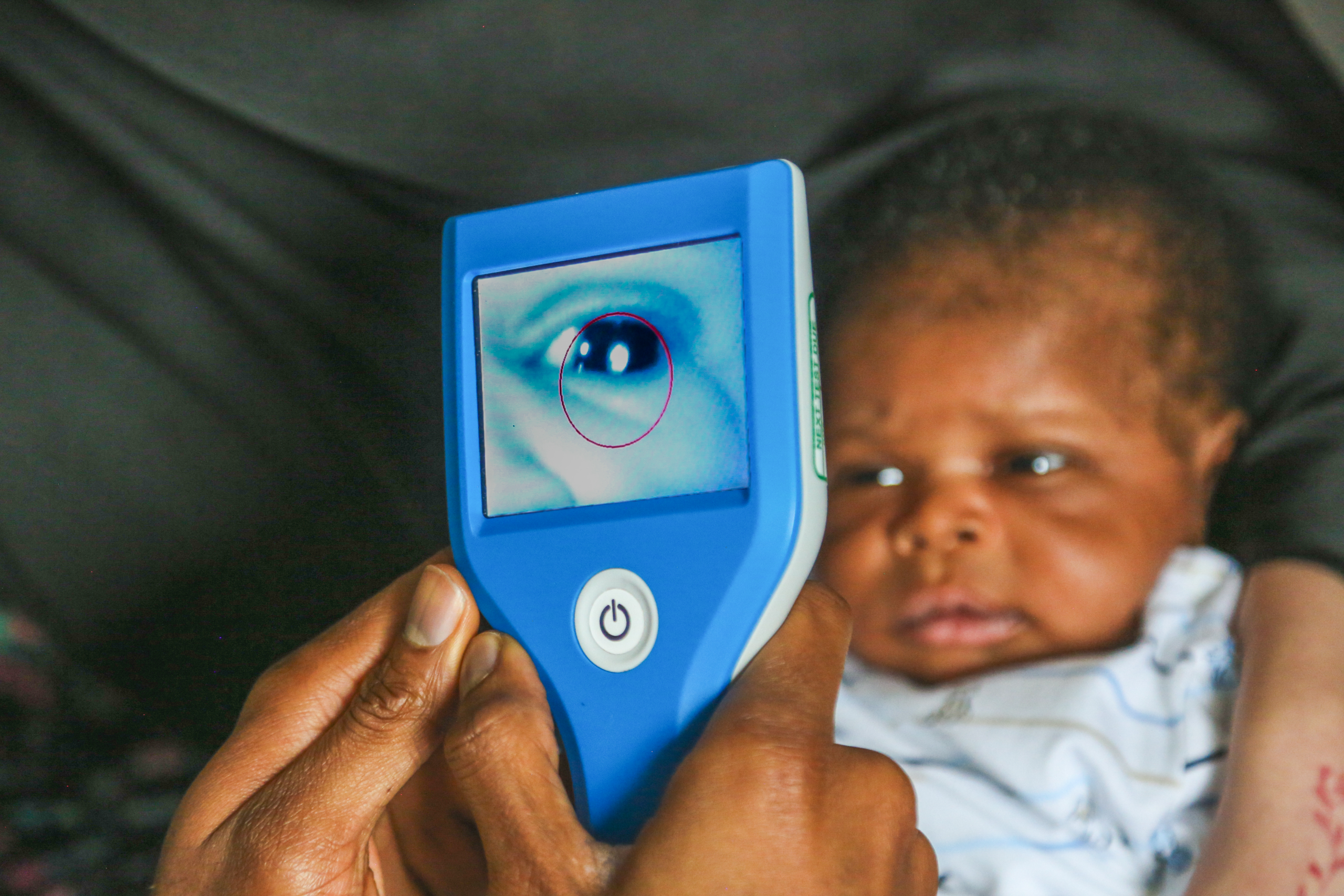
42T had previously worked with Neocam Ltd to develop Neocam, a handheld digital imaging device designed to support more consistent newborn eye screening. The concept originated from Dr Louise Allen and aimed to address limitations in conventional screening, including missed cases and false positives. Neocam was subsequently used in the NIHR-funded DIvO study to collect thousands of clinically assessed infant-eye images, creating a labelled dataset that could support new approaches to image assessment.
Several years later, that dataset created a new opportunity to explore the use of AI in newborn eye screening. Dr Louise Allen and Cambridge University Hospitals wanted to understand whether machine learning could support this process. The aim was to help screeners assess image quality and identify images requiring clinical review, reducing reliance on individual experience.
42T’s solution
Having previously developed the Neocam platform, 42T combined its knowledge of the device and its real-world use with AI expertise, including machine learning and Deep learning approaches. Working with Dr Louise Allen and the clinical team at Addenbrooke’s Hospital, the team developed and compared approaches to assess image quality and identify images requiring clinical review or retaking. The models were benchmarked against a clinical gold standard to identify the most promising approach. Because abnormal cases were relatively rare within the dataset, 42T also explored techniques to strengthen the available training data and improve model robustness.
The work considered both model performance and how the technology could ultimately be deployed at the edge. Running image assessment locally on a future handheld device could reduce reliance on cloud processing, give screeners immediate feedback at the point of care and reduce the risk of personal data being compromised.
By combining AI expertise, embedded systems and medical-device development, 42T gave the Cambridge University Hospitals NHS Trust clear evidence on where to focus further development and how the selected approach could progress towards embedded deployment.
“Incorporating AI into a potentially new, digitalised newborn screening service will support non-specialist screening staff to record good-quality eye images and alert the screener to images which require expedited specialist image review”
Why 42T?
Embedded AI expertise
Developing machine learning and deep learning approaches with edge deployment in mind, creating a route towards intelligent processing directly on the device.
In-depth product understanding
Building on detailed knowledge of products and systems to make better-informed technical decisions across successive stages of development.
Multidisciplinary engineering
Combining Edge AI, embedded systems and medical-device expertise to consider both model performance and the practical requirements of future product development.
Andy has over 35 years of experience in product design, including 20 years specialising in medical devices. His expertise spans industrial design, human factors and usability, with extensive experience developing products for clinical environments.
Mike is a Chartered Engineer and Head of AI at 42T, with extensive experience in embedded systems and software development. His expertise includes integrating machine learning and Edge AI into products, with a focus on practical solutions that run locally on embedded devices.
Let us help you
Explore how our Edge AI expertise could help bring intelligent capabilities to your medical device, from early feasibility through to practical deployment.